Article
Mustang: The Last Forbidden Kingdom in the Clouds
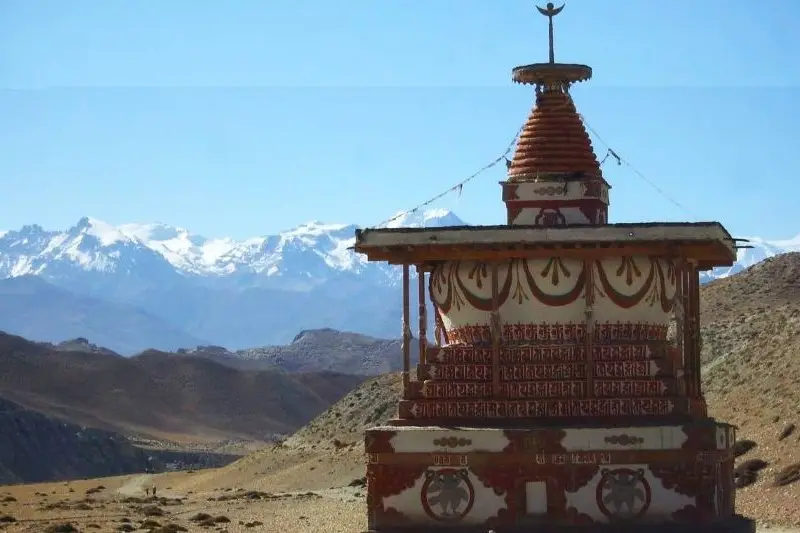
Mustang Nepal: Landscapes, Culture and Heritage
Most people hear “Mustang” and think of a muscle car tearing down a highway. At a travel show once, someone even asked if our Mustang trip was by Ford Mustang. Her next guess, wild horses, wasn’t any closer.
Like many travelers, she had no idea that Mustang is also the name of an ancient Himalayan kingdom tucked deep inside Nepal, pronounced Moostang, and about as far from a freeway as you can get.
Here, Mustang means wind-carved cliffs, high-desert valleys, ancient Buddhist monasteries, traditional villages, and the historic walled city of Lo Manthang.
It is a place where the landscape changes dramatically from one valley to the next, where centuries-old cultural traditions remain part of everyday life, and where an annual Buddhist festival transforms Lo Manthang into the setting for three days of sacred ceremonies and masked dances.
This is Mustang.
A Kingdom Hidden Behind the Himalayas
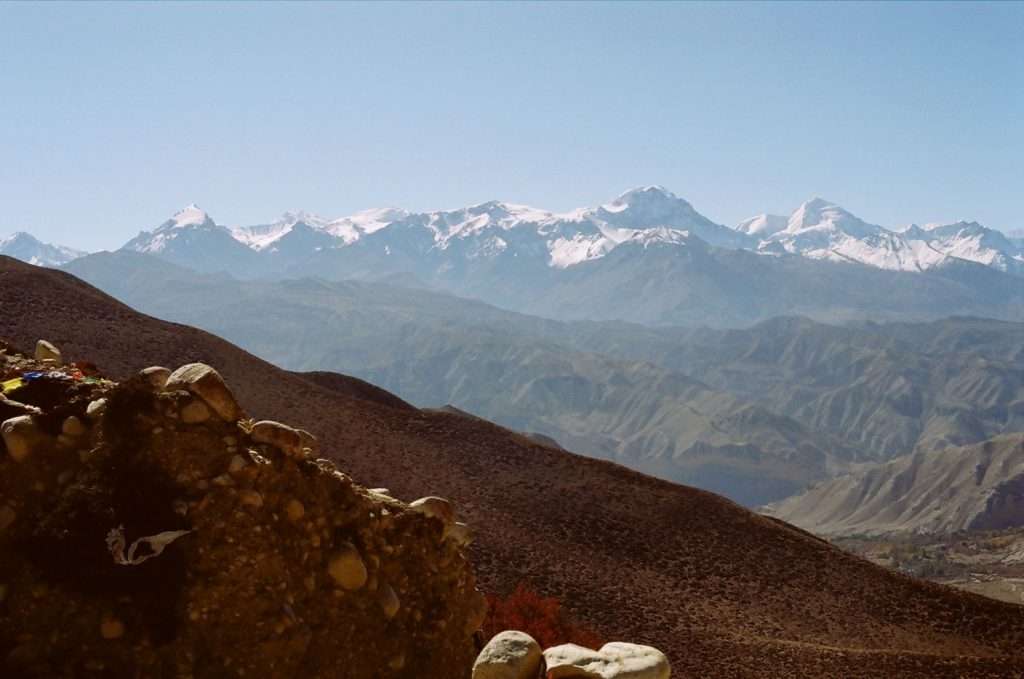
Upper Mustang, once known as the Kingdom of Lo, lies beyond the Annapurna and Dhaulagiri ranges in the rain shadow of the Himalayas.
The landscape is remarkably different from the lush green hills and forests associated with much of Nepal. Dry plateaus, deep valleys, sandstone cliffs, colorful rock formations, and high mountain passes dominate the region.
The isolation of Upper Mustang helped preserve a distinctive cultural landscape shaped by centuries of Tibetan Buddhist influence.
Traditional villages sit among barren hills. Whitewashed houses contrast with red and ochre cliffs. Monasteries and chortens appear throughout the valleys, while fields of barley and other crops provide patches of green in an otherwise arid landscape.
At the center of this cultural world is Lo Manthang, the historic capital of the former Kingdom of Lo.
The region was opened to foreign travelers in the early 1990s, and its restricted status helped limit large-scale tourism for decades. Today, Mustang is more accessible, but its distinctive cultural identity and dramatic environment remain central to the experience.
A Kingdom of Trade, Culture and the Himalayas
Mustang’s history is closely connected to trade across the Himalayas.
For centuries, routes through the Kali Gandaki corridor connected communities on the southern side of the Himalayas with Tibet and the wider trans-Himalayan region. Salt, grain, wool, livestock, and other goods moved through these mountain routes.
The legacy of that history can still be seen in Mustang’s villages, monasteries, fortifications, trails, and traditional architecture.
The region’s cultural heritage is particularly visible in its Buddhist monasteries and religious monuments. Tibetan Buddhist traditions continue to influence festivals, rituals, art, architecture, and community life.
That combination of history, geography, and living culture is what makes Mustang more than simply a scenic mountain destination.
What Makes Mustang So Special?
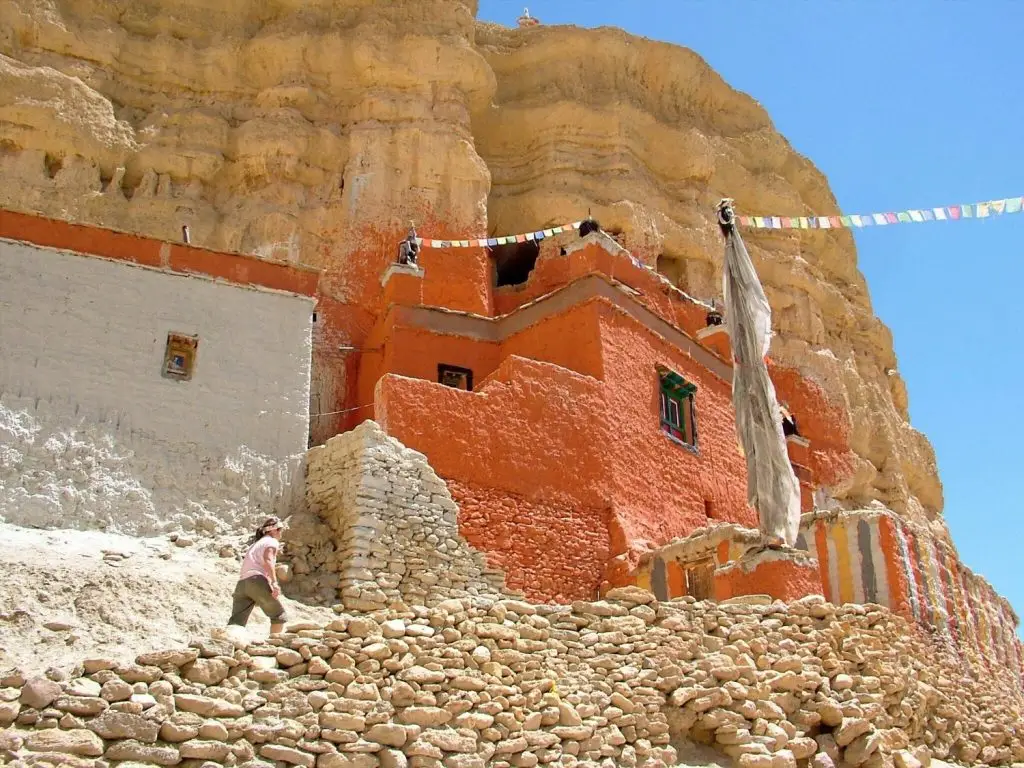
Travelers come to Mustang for different reasons, but several experiences define the region.
Dramatic High-Desert Landscapes
Mustang’s landscape is one of the first things visitors notice.
Instead of dense forests and green mountain slopes, Upper Mustang is characterized by expansive high-altitude valleys, barren plateaus, deep canyons, and cliffs sculpted by wind and erosion.
The colors can change throughout the day. Morning light brings out softer earth tones, while late afternoon sunlight can turn cliffs deep red, orange, and gold.
The contrast between the dry landscape and snow-covered Himalayan peaks creates some of Nepal’s most distinctive mountain scenery.
Ancient Buddhist Heritage
Monasteries are woven into the cultural landscape of Mustang.
Historic religious sites can be found in villages and remote valleys, with traditional murals, statues, prayer walls, chortens, and other expressions of Tibetan Buddhist heritage.
Among the places travelers may encounter are Jampa Lhakhang, Thubchen Gompa, Namgyal Gompa, Ghar Gompa, and other village monasteries.
Some monasteries remain active religious spaces, so visits should always be approached with respect for local customs and any restrictions on photography or access.
Traditional Villages
Mustang’s villages offer a glimpse into a way of life shaped by altitude, climate, agriculture, trade, and religion.
Settlements such as Marpha, Kagbeni, Ghami, Charang, and Lo Manthang each have their own character.
Whitewashed homes, narrow lanes, stone walls, prayer flags, chortens, agricultural fields, and monasteries create a distinctive architectural and cultural landscape.
Cliffside Caves
One of Mustang’s most intriguing features is its extensive network of caves carved into cliffs.
The Chhoser Valley, near Lo Manthang, contains several remarkable cave complexes, including Jhong Cave, Nyphu, and Garphu.
Their exact history and original uses are subjects of ongoing study and interpretation. They may have served different purposes at different periods, including habitation, religious practice, storage, or burial.
Rather than assuming every cave has a single known purpose, part of their fascination lies in the questions they continue to raise about the people who once lived in these cliffs.
Places to Discover in Mustang
A journey through Mustang can include a remarkable variety of cultural and natural attractions.
Marpha
Marpha is one of the best-known villages in the lower Mustang region.
Its stone-paved lanes, whitewashed houses, traditional architecture, orchards, and Thakali cultural heritage make it a popular stop on journeys into Mustang.
The village is also associated with apples and locally produced apple products.
Muktinath
At approximately 3,800 meters, Muktinath is one of Nepal’s most important pilgrimage destinations.
The sacred site is significant to both Hindu and Buddhist traditions. Visitors can see the temple complex, sacred water sources, and Jwala Mai, associated with a natural flame.
The combination of pilgrimage, mountain scenery, and high-altitude landscape makes Muktinath an important part of the Mustang experience.
Kagbeni
Kagbeni lies near the confluence of the Kali Gandaki and Jhong Khola rivers.
Its narrow lanes, traditional earthen architecture, chortens, and Buddhist heritage make it one of the most atmospheric settlements in the region.
Kagbeni is also an important gateway for travelers continuing into restricted Upper Mustang.
Ghami
Ghami is surrounded by dramatic mountain scenery and is known for its prominent mani wall, decorated with carved Buddhist prayer stones.
The village provides an opportunity to see how religious monuments and traditional settlements are integrated into Mustang’s landscape.
Dhakmar
The red and ochre cliffs surrounding Dhakmar are among Mustang’s most recognizable natural features.
The village sits beneath striking rock formations whose colors become particularly vivid in certain light.
Charang
Charang, also known as Tsarang, is a historic settlement on the route toward Lo Manthang.
Its traditional buildings, religious sites, surrounding fields, and dramatic landscape make it an important cultural stop in Upper Mustang.
Lo Manthang
Lo Manthang is the cultural heart of Mustang.
The historic walled city contains traditional buildings, monasteries, narrow streets, and landmarks associated with the former Kingdom of Lo.
Important cultural sites include Jampa Lhakhang, Thubchen Gompa, Namgyal Gompa, and the historic royal complex.
But Lo Manthang is not simply a collection of historic buildings. It remains a living community, and that distinction becomes particularly important during the annual Tiji Festival.
Lo Manthang: The Cultural Heart of Mustang

Approaching Lo Manthang is one of the defining moments of a Mustang journey.
The surrounding landscape opens into a broad, high-altitude valley, while the historic settlement stands out against the surrounding mountains.
Inside the old city, traditional buildings and monasteries line narrow streets. Religious structures, residences, courtyards, and community spaces exist alongside modern elements of everyday life.
The city’s cultural importance becomes especially visible during major religious celebrations.
The most famous of these is Tiji Festival.
Tiji Festival: Mustang's Great Cultural Celebration
Every year, Lo Manthang becomes the setting for the Tiji Festival, a three-day Buddhist celebration featuring masked dances, music, rituals, and community gatherings.
For travelers interested in Mustang’s culture, the festival provides an opportunity to see traditions that are deeply connected to the religious life of the region.
Tiji is traditionally associated with the story of Dorje Jono, a figure connected with protecting the region from destructive forces.
The festival presents this story through ritual performances and masked dances known as Chham.
The exact ceremonies and sequence can vary according to the official program, but the three-day celebration generally includes:
Sacred masked dances
Traditional Buddhist music
Elaborate ceremonial costumes and masks
Religious rituals
Monastic performances
Community gatherings
Concluding ceremonies and processions, depending on the year’s program
The festival takes place against the backdrop of historic Lo Manthang, making the experience particularly distinctive.
Tiji Festival Is More Than a Performance
Visitors sometimes encounter Tiji Festival through photographs of colorful masks and dramatic dances.
But the festival is more than a visual spectacle.
It is a religious and cultural event for the people of Lo Manthang and surrounding communities.
Travelers are guests at the celebration, so respectful behavior matters.
When attending the festival:
Follow your guide’s instructions.
Respect areas marked as restricted.
Ask before photographing people.
Follow photography restrictions during ceremonies.
Do not interrupt monks or performers for photographs.
Avoid touching religious objects or ritual items.
Dress respectfully.
Remain aware of where you stand during processions and performances.
Taking time to observe the festival rather than viewing it solely as a photographic opportunity can make the experience much more meaningful.
When Is Tiji Festival?
Tiji Festival follows the Tibetan Buddhist calendar, so its dates change from year to year.
For 2027, Tiji Festival in Lo Manthang is scheduled for June 1–3, 2027.
For 2028, Tiji Festival in Lo Manthang is scheduled for May 21-23, 2028.
The three-day schedule makes timing important for travelers.
Rather than arriving in Lo Manthang on the morning of the first ceremony, a journey planned around the festival should allow sufficient time to travel through Mustang and arrive before the celebrations begin.
For travelers planning specifically around the 2027 festival, Far & High’s 15-Day Upper Mustang Tiji Festival Tour is scheduled for May 24–June 7, 2027, with all three festival days included from June 1–3.
Why Combine a Mustang Journey with Tiji Festival?
Visiting Mustang during Tiji Festival provides two different experiences in one journey.
First comes the exploration of Mustang itself: the Kali Gandaki region, pilgrimage sites, traditional villages, monasteries, dramatic cliffs, and high-altitude landscapes.
Then comes time in Lo Manthang during one of its most important annual celebrations.
This means travelers experience Mustang not only as a landscape but also as a living cultural region.
The festival also provides a different perspective on places that might otherwise be experienced primarily as historic attractions. Lo Manthang’s streets, monasteries, and community spaces become part of an active cultural celebration.
Best Time to Visit Mustang
The best time to visit Mustang depends on what you want to experience.
Spring
Spring generally offers favorable conditions for exploring the region.
March through May brings increasingly warmer conditions, while the landscape remains relatively dry compared with much of Nepal.
Spring is also significant for travelers interested in Tiji Festival, whose dates generally fall according to the Tibetan Buddhist calendar rather than a fixed Gregorian date.
Summer and Monsoon
Upper Mustang lies in the rain shadow of the Annapurna and Dhaulagiri ranges, so it receives much less monsoon rainfall than many other parts of Nepal.
This makes Mustang unusual among Himalayan destinations during Nepal’s summer monsoon.
However, conditions in the lower valleys and on transportation routes can still be affected by rain, road conditions, and weather.
Autumn
September through November is another popular period for visiting Mustang.
Clear mountain conditions can provide excellent views, while daytime temperatures are generally comfortable for exploration.
Winter
Winter brings colder conditions and can affect access, accommodation, and local services at higher elevations.
Travelers considering a winter journey should check current conditions and the availability of accommodation and transportation before traveling.
Mustang's High-Altitude Environment
Mustang is a high-altitude destination, and visitors should understand how elevation can affect travel.
Some important elevations include:
Pokhara: approximately 820 m / 2,690 ft
Kagbeni: approximately 2,804 m / 9,199 ft
Muktinath: approximately 3,800 m / 12,467 ft
Lo Manthang: approximately 3,840 m / 12,598 ft
High mountain passes: around 4,000 m / 13,000 ft, depending on route
Even travelers who are not trekking can experience altitude-related effects.
A gradual itinerary, reasonable pacing, adequate rest, and attention to symptoms are important.
Anyone with concerns about high-altitude travel or an existing medical condition should discuss their plans with an appropriate healthcare professional before departure.
Experience Mustang and Tiji Festival
Mustang is not simply a destination to check off a Nepal itinerary.
It is a place where the landscape and culture are closely connected: where monasteries stand against barren cliffs, traditional villages sit beside agricultural fields, and centuries-old Buddhist traditions remain part of community life.
The journey through Mustang leads from the greener valleys of central Nepal into a high-altitude world of ochre cliffs, dry river valleys, ancient settlements, and the historic city of Lo Manthang.
And once a year, Lo Manthang takes on another dimension.
During Tiji Festival, the city becomes the setting for three days of sacred dances, music, rituals, and community celebration.
For travelers who want to experience Mustang during this remarkable event, explore Far & High’s 15-Day Upper Mustang Tiji Festival Tour 2027, scheduled around the June 1–3 festival.
For travelers interested in exploring Upper Mustang at other times of year, discover Far & High’s Upper Mustang by 4WD journey.
Mustang may once have been difficult for outsiders to reach, but its character remains shaped by the same mountains, culture, and traditions that made it so fascinating in the first place.
Some journeys are about reaching a destination.
Mustang is about discovering a world along the way.
FAQs
Where is Mustang in Nepal?
Mustang is a district in north-central Nepal, extending from the lower Kali Gandaki region into the high-altitude landscapes of Upper Mustang near the Tibetan border.
What is Upper Mustang
Upper Mustang is the northern part of Mustang, historically associated with the Kingdom of Lo and centered around Lo Manthang. It is known for its high-desert landscapes, Tibetan Buddhist heritage, traditional villages, monasteries, and cave complexes.
Why is Mustang called the Forbidden Kingdom?
Mustang became known internationally as the “Forbidden Kingdom” because access to Upper Mustang was historically restricted to foreign travelers. Although the region is now open to permitted tourism, the name remains associated with its long period of isolation.
What is Lo Manthang famous for?
Lo Manthang is known for its historic walled settlement, Buddhist monasteries, traditional architecture, cultural heritage, and its role as the former capital of the Kingdom of Lo. It is also the main setting for the annual Tiji Festival.
What Is Travel Like in Mustang?
Mustang is remote, and that is part of its appeal.
Travelers should be prepared for a different pace from ordinary sightseeing trips.
Mountain roads can be rough and dusty, travel times can change, and weather can affect transportation.
Accommodation becomes simpler as you move farther into Upper Mustang. Guesthouses and lodges provide the essentials, but facilities such as hot water, electricity, heating, Wi-Fi, and charging can vary.
Meals generally include familiar Nepali and Himalayan dishes such as:
Dal bhat
Momos
Thukpa
Tibetan bread
Noodles
Rice and vegetables
Eggs
Potatoes
Soups
Travelers should approach Mustang with flexibility rather than expecting the same conveniences available in Kathmandu or Pokhara.
Is Trekking Gone?
Not at All. Now that jeeps can reach Upper Mustang, some assume trekking has disappeared. It hasn’t. People still trek, but the experience has changed. Many old trails now run alongside the road, and the once‑remote paths feel less isolated than before. Trekkers miss the old quiet, but accessibility has opened Mustang to people who once could only dream of it.
And the magic remains. The cliffs still glow at sunset. The caves still cling to impossible heights. The monasteries still hum with ancient chants. The Himalayas still rise around you, strangely dwarfed by Mustang’s vast desert plateau.
Can You Travel Independently?
Yes… with One Rule
You can plan your own dates, pace, and route, but you can’t enter Upper Mustang completely solo. A licensed Nepali guide is required. It’s not a restriction so much as a safeguard. Mustang is remote, high, and culturally delicate, and having someone who knows the land makes the journey richer and safer.
Local operators know which roads are open, which monasteries welcome visitors, and how to pace the trip so you acclimatize comfortably. And if altitude sickness or a sudden weather change hits, they can arrange quick evacuation or medical help, something that’s hard to manage alone in such a remote region.
Is Mustang Right for You?
Mustang can be a rewarding destination for travelers who enjoy culture, history, dramatic landscapes, and journeys into remote regions.
It may appeal particularly to travelers who:
Want to experience a distinctive Himalayan culture
Enjoy visiting historic monasteries and villages
Are interested in Tibetan Buddhist traditions
Want to see high-altitude desert landscapes
Enjoy photography and dramatic scenery
Want to experience Lo Manthang
Are interested in Tiji Festival
Are comfortable with basic mountain travel and changing conditions
Mustang may be less suitable for travelers looking for resort-style accommodation, predictable transportation, or a conventional sightseeing itinerary.
The region rewards patience and curiosity.
How Long Should You Spend in Mustang?
There is no single answer because the ideal duration depends on your interests.
A shorter journey can focus on the major settlements and cultural sites, while a longer itinerary allows more time for exploration and acclimatization.
Travelers visiting specifically for Tiji Festival need to plan around the three festival days and allow enough time to reach Lo Manthang before the opening ceremonies.
A broader journey can combine destinations such as:
Marpha → Muktinath → Kagbeni → Charang → Lo Manthang → Chhoser → Jomsom
with additional time for cultural sites and local exploration.
If you want to experience all three days of Tiji Festival 2027 while exploring Upper Mustang before and after the celebration, see Far & High's 15-Day Upper Mustang Tiji Festival Tour 2027. If you can not travel during the Tiji Festival, Far & High offers a 12-Day Upper Mustang 4WD Tour throughout the year.
Caution! Some commercial tour operators targeting local travelers offer shorter 5–7‑day itineraries, but these involve long driving days with fewer sights to enjoy and may also pose altitude risks.
What is Tiji Festival?
Tiji Festival is a three-day Buddhist celebration held in Lo Manthang. It features masked dances, religious rituals, traditional music, costumes, and community gatherings and is traditionally associated with the story of Dorje Jono.
When is Tiji Festival 2027 and Tiji Festival 2028?
Tiji Festival 2027 is scheduled for June 1–3, 2027, in Lo Manthang, Upper Mustang.
Tiji Festival 2028 is scheduled for May 21-23, 2028 in Lo Manthang, Upper Mustang
Can you visit Mustang without trekking?
Yes. There are several ways to explore Mustang, including vehicle-based journeys and trekking itineraries. Even when traveling by vehicle, visitors should expect walking at villages, monasteries, cultural sites, and other attractions.
How high is Lo Manthang?
Lo Manthang is approximately 3,840 meters (12,598 feet) above sea level.
Is Mustang difficult to travel?
Mustang is a remote, high-altitude destination. Travelers should expect rough mountain roads, basic accommodation in some locations, changing weather, and limited services in remote areas.
Do you need a permit to visit Upper Mustang?
Upper Mustang is a restricted area with specific permit requirements. Regulations and fees can change, so travelers should confirm current requirements before departure through a registered travel agency such as Far & High or the relevant authorities.
What is the best time to visit Mustang?
Spring and autumn are popular periods for visiting Mustang. Spring is particularly interesting for travelers who want to experience Tiji Festival, while autumn is known for generally favorable mountain conditions.
Join our community
News, new trips and festival dates from Postak. Unsubscribe any time.