Travel guide
Mongolia Travel Guide

Traveling to Mongolia is an adventure into vast steppe landscapes, nomadic culture, and some of the most remote corners of Asia. Before you go, it’s helpful to understand the essentials, passport and visa requirements, the best ways to reach Mongolia and travel onward, how to manage money, stay connected, and navigate local customs. Whether you’re exploring Ulaanbaatar or venturing deep into the Gobi, knowing these basics will make your journey smoother and far more rewarding.
Entry Requirements for Mongolia
Passport
Visitors to Mongolia must hold a passport that remains valid for at least six months beyond their arrival. Ensure your passport has at least one blank visa page available for entry and exit stamps.
Visa-Free Access
Citizens of more than 60 countries, such as the United States (visa‑free for up to 90 days), Canada (up to 30 days), and many European nations (up to 30 days), can enter Mongolia without needing a visa.
Visa/E-Visa
Visitors from countries not on the exemption list must apply for a visa/eVisa. While you can apply conventional visa at Mongolian diplomatic missions near your hometown, you can also apply for an eVisa online.
Registration
All foreign visitors staying more than 30 days must register with the Immigration Agency of Mongolia within the first seven days after arrival.
Proof of Onward Travel
You may be asked to show a return or onward ticket and accommodation details.
How to Get to Mongolia and Away
Mongolia is a landlocked country between Russia and China, and so getting to and from Mongolia is most commonly done by air or rail.
By Air
Direct flights to Mongolia operate from several major Asian and European cities, including Seoul, Beijing, Tokyo, Hong Kong, Istanbul, and Frankfurt.
The main airlines serving these routes are MIAT Mongolian Airlines, Hunnu Air, Aero Mongolia, Turkish Airlines, Korean Air, and Air China.
Travelers from North America should note that there are no nonstop flights from the U.S. or Canada; most itineraries route through hubs such as Seoul (Korean Air/Asiana), Istanbul (Turkish Airlines), or Tokyo (United Airlines/ANA).
By Rail
The Trans‑Mongolian Railway offers the classic overland route linking Ulaanbaatar with neighboring countries.
From China: Trains operate between Beijing and Ulaanbaatar, with the journey taking roughly 30 hours. Many travelers instead take a domestic train to the border town of Erenhot, cross into Zamiin‑Uud, and continue onward by Mongolian rail to the capital.
From Russia: Regular train services connect Ulaanbaatar with Ulan‑Ude, Irkutsk, and all the way to Moscow.
Important Note: Travel through Russia currently comes with significant advisories due to the ongoing conflict in Ukraine.
By Car or Bus
Borders: The primary year-round border crossings for foreigners are Zamiin-Uud (China) and Altanbulag (Russia).
Bus: Daily buses operate between Ulan-Ude (Russia) and Ulaanbaatar (approx. 12-15 hours).
Driving: Entering by private 4×4 or motorcycle is possible but requires complex paperwork, including vehicle import permits and potentially a temporary Mongolian driving permit.
The Best Time for Travel to Mongolia
From the sweltering heat of the Gobi to the bone-chilling stillness of the taiga, Mongolia is a land of dramatic atmospheric shifts. Choosing when to visit depends entirely on whether you’re chasing the vibrant energy of the Naadam Festival or the quiet, golden solitude of the autumn steppe. Here is a breakdown of what to expect across the four distinct seasons of the “Land of the Eternal Blue Sky.
Summer (June – August): The Peak & Vibrant Season
What to Expect: Mild to warm days ( to ) and the most rainfall, though it remains relatively dry. The steppe is at its greenest.
Best For: First-time visitors, overland expeditions, and the Naadam Festival in July (archery, horse racing, and wrestling).
Perks: Longest daylight hours and fully operational tourist ger camps.
Challenges: Peak crowds, higher prices, and “mozzies” (mosquitoes) in the north. The Gobi can be punishingly hot, reaching 40 °C (104 °F)
Fall (September – October): The Photographer’s Dream
What to Expect: Crisp air and a “kaleidoscope of color” as the larch forests turn golden.
Best For: Photography, hiking, and the Golden Eagle Festival in western Mongolia (early October).
Perks: Far fewer tourists than summer and pleasantly warm days with no mosquitoes.
Challenges: Temperatures drop rapidly at night, occasionally hitting -20 °C(-4 °F) by late October. Many ger camps begin to close for the season. Many international and domestic airlines will reduced the number of flights they operate.
Winter (November – February): The Brutal and Serene Adventure
What to Expect: Extreme cold, with averages around -30 °C (-22 °F), plunging to -50 °C (-58 °F) in some regions.
Best For: Hardcore adventurers, ice festivals (like the Khuvsgul Ice Festival in March), and dog sledding.
Perks: Stunning frozen landscapes, unique winter nomadic life, and zero crowds.
Challenges: Serious health risks from cold, heavy smog in Ulaanbaatar, and most rural infrastructure being inaccessible.
Spring (March – May): The Season of Extremes
What to Expect: A time of “awakening” but also the most unpredictable weather. Dust storms and fierce winds are common.
Best For: Seeing newborn livestock, migration of herder families, and the Camel Festival (early March).
Perks: Competitive prices and a quiet, peaceful atmosphere.
Challenges: High winds (up to 140km/hr) can ground flights and make outdoor activity difficult. Livestock is often weak, limiting horse trekking opportunities.
Currency & Payments
The official currency of Mongolia is the Mongolian Tögrög (MNT), also spelled tugrik or tugrug, symbolized by ₮. While the country is rapidly digitizing, a combination of cash and card is the most reliable way to navigate both urban and rural areas.
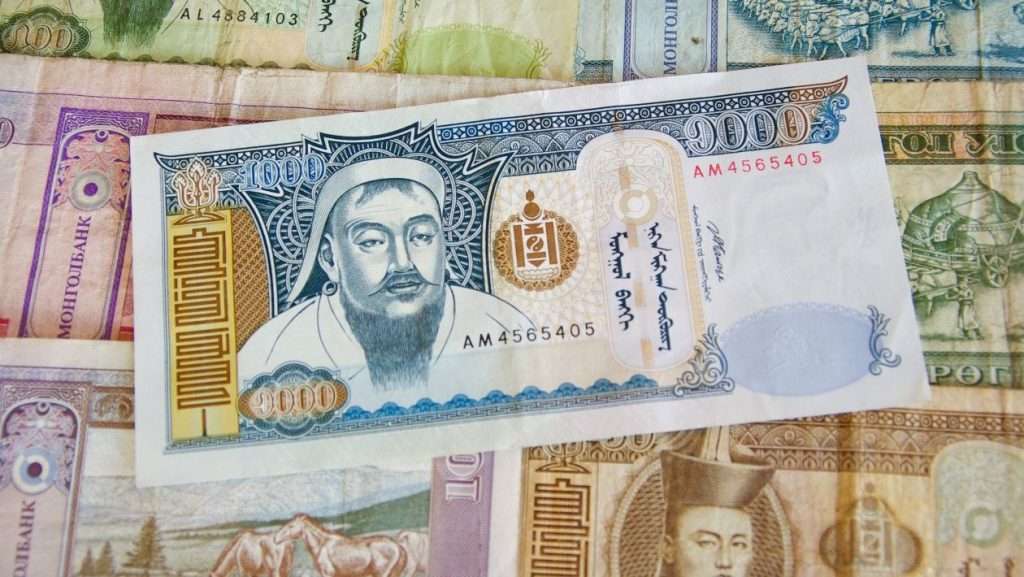
Mongolian Currency – Tugrik. Photo Credits: jackmac34
Denominations: Banknotes range from 10 to 20,000 MNT. Notes smaller than 100 MNT and coins are rarely used in daily transactions.
Exchange Rate: As of late March 2026, $1 USD is approximately 3,570 MNT.
Official Tender: Legally, all transactions must be conducted in Tögrög. While some tourist establishments may accept USD or EUR, the exchange rate offered will likely be poor.
Payment Methods
Cash: Cash is “king” outside major cities. Small shops, nomadic stays, and local markets typically do not have card terminals. If bringing US Dollars to exchange, ensure bills are new, crisp, and printed after 2000; banks often reject damaged or older series notes
Cards (Visa/Mastercard): Widely accepted in Ulaanbaatar at hotels, supermarkets, and restaurants.
ATMs: Common in Ulaanbaatar and provincial centers; most accept international Visa and Mastercard.
Digital Walltets & QR Codes:
The domestic QPay system (QR-based) is ubiquitous among locals.
Foreign Wallets: Support for Apple Pay and Google Pay is growing in Ulaanbaatar but remains inconsistent. AliPay and WeChat Pay are generally not supported for foreigners outside mainland China.
Important Tips:
Exchange Location: Use official banks or exchange offices in the city for the best rates. Avoid black-market changers.
Currency Export: MNT is a non-convertible currency; exchange any remaining cash back to a major currency before leaving the country, as it is difficult to trade elsewhere.
Traveler’s Checks: These are no longer accepted in Mongolia.
Connectivity in Mongolia
Although Ulaanbaatar offers excellent digital connectivity, rural Mongolia is still a mix of modern satellite access and large areas with no signal at all.
Mobile Networks & SIM Cards
Best Coverage: Mobicom and Unitel offer the most extensive 4G LTE networks, covering all provincial centers and many smaller village (sum) centers.
5G Availability: Nationwide 5G was officially launched in May 2025. While primarily centered in Ulaanbaatar, pilot networks exist in all 21 provincial capitals.
Tourist SIMs: Available at Chinggis Khaan International Airport and city stores. A typical 30-day tourist SIM with large data allowances (e.g., 100GB) costs roughly $10 USD.
eSIMs: Providers like Holafly and Airalo offer Mongolia-specific data plans, which are convenient for immediate connection upon landing.
Internet & Wi-Fi
Urban Areas: Ulaanbaatar has high-speed fiber-optic internet. Free Wi-Fi is standard in hotels, cafes, and even some public spaces, with speeds often exceeding 60–100 Mbps.
Rural Areas (The Steppe): Traditional Wi-Fi is rare in nomadic areas. Most “ger camps” do not have standard internet, though some high-end lodges now provide it via satellite.
The “Starlink” Shift: As of 2024–2026, Starlink is legally operating in Mongolia, significantly improving high-speed access for remote tourist camps and nomadic families.
Essential Cultural Etiquette in Mongolia
Mongolian etiquette draws heavily from its nomadic heritage and Buddhist values, emphasizing deep respect for hosts, the home, and the land.
Temples & Monasteries
Clockwise Movement: Always move clockwise around stupas, prayer wheels, and within temple spaces.
Dress Code: Modest clothing is expected, long sleeves and trousers are ideal. Remove your hat, sunglasses, and shoes before entering a prayer hall.
Sacred Objects: Avoid touching altars, thangkas, or statues. When seated, keep your feet pointed away from the altar, and never turn your back to it directly, step back slightly before turning away.
Body Language & Gestures
Right‑Hand Custom: Always offer or receive items, whether money, gifts, or food, with your right hand or with both hands. Using only the left hand is seen as disrespectful.
“Foot Bump” Etiquette: If you accidentally step on someone’s foot, it’s customary to immediately shake their hand or lightly touch their arm to restore harmony and avoid bad luck.
Pointing: Avoid pointing at people, sacred sites, or mountains with your index finger. Use an open hand with your palm facing upward instead.
Heads & Hats: The head is considered sacred, so never touch another person’s head, including a child’s. Hats should also be treated with care, don’t place them on the ground or sit on them; keep them elevated.
Social Etiquette: Visiting a Nomadic Family in their Ger (Yurt)
Announce Your Arrival: Instead of knocking, call out “Nokhoi khor!” (“Hold the dog!”) as you approach a ger so the family knows you’re coming and can secure their dogs.
Mind the Threshold: Never step on the wooden threshold of the doorway, it’s considered the “neck” of the household spirit. Step over it, usually starting with your right foot.
Inside Movement: Enter and move to the left, following a clockwise flow. Guests are typically seated on the left side, while the honored northern section is reserved for elders and the family altar.
Respect the Fire: The central hearth is spiritually significant. Don’t throw rubbish or water into the fire, and avoid pointing your feet toward it.
Table Manners & Hospitality
Accept What’s Offered: You’ll likely be served salty milk tea (suutei tsai) and dried curds (aaruul). It’s important to accept these offerings, even a small sip or bite is enough, as declining hospitality is considered rude.
Vodka Customs: When offered vodka, take the bowl with your right hand. Dip your ring finger into it and flick a drop to the sky (honoring Tengri), the wind, and the earth, then touch your forehead. After that, you may take a sip or hand the cup back.
Handling Bowls: Hold cups and bowls from the base or with an open palm rather than gripping them by the rim.
Photography
Ask First: A rule of thumb, always ask permission before photographing locals, especially elders and monks.
Restrictions: Photography is frequently banned inside active temples. Look for “No Photo” signs. If unsure, ask.
Join our community
News, new trips and festival dates from Postak. Unsubscribe any time.